FIFA World Cup 2026 Schedule in Australia Time (AEST)
All 104 matches in your local Australia time. Pick AEST / ACST / AWST below.
Group Stage (72 matches)
Round of 32 (16 matches)
Round of 16 (8 matches)
Quarter-final (4 matches)
Semi-final (2 matches)
Match for Third Place (1 match)
Final (1 match)
The FIFA World Cup 2026 runs from June 11 to July 19, hosted by Canada, Mexico, and the United States across 16 cities. Page times default to Australian Eastern Standard Time (AEST, UTC+10) since Sydney, Brisbane, Melbourne, and Canberra anchor the largest concentration of Australian football viewers, with secondary Adelaide (ACST, UTC+9:30) and Perth (AWST, UTC+8) timezones surfaced on the page. None of these zones observe daylight saving in June and July (winter in Australia), so the offsets are constant.
Match scheduling sits in a familiar Australian pattern: late-night and early-morning kick-offs. Mexico City and US Eastern Time hosts (Boston, New York, Philadelphia, Atlanta, Miami, Toronto) typically kick off between 02:00 and 13:00 AEST. US Central Time hosts (Dallas, Houston, Kansas City) push starts to 03:00 to 14:00 AEST. US Pacific Time hosts (Seattle, San Francisco, Los Angeles, Vancouver) run from 05:00 to 16:00 AEST, the most viewer-friendly window for Australian fans, especially weekend afternoon matches.
The Socceroos play in Group D alongside Türkiye, USA, and Paraguay. The team opens against Türkiye in Vancouver (Saturday, June 13, 14:00 AEST on Sunday, June 14, an early-afternoon Sunday kick), faces co-host USA in Seattle (Friday, June 19, 05:00 AEST on Saturday, June 20, an early-Saturday-morning fixture), and closes the group against Paraguay in San Francisco Bay Area (Thursday, June 25, 12:00 AEST on Friday, June 26, midday Friday). The Sunday afternoon Türkiye opener is the friendliest viewing window of the campaign for the eastern Australian audience.
Shop the Australia kit
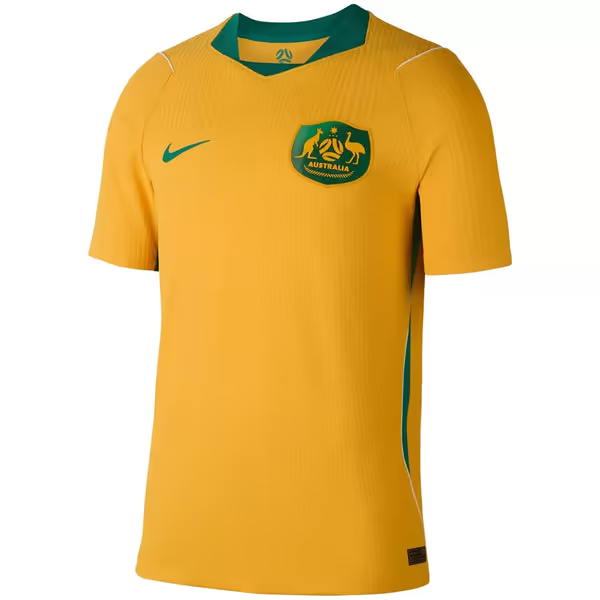
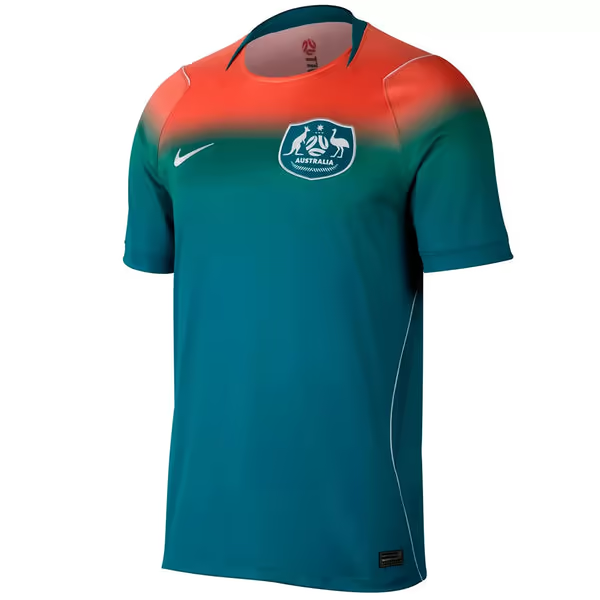
The FIFA World Cup 2026 runs June 11 to July 19, 2026. All 104 matches in Australia local time across AEST / ACST / AWST. Opening match is Mexico vs South Africa on Fri Jun 12, kicking off at 5:00 AM AEST / 4:30 AM ACST / 3:00 AM AWST. Final is Mon Jul 20 at 5:00 AM AEST / 4:30 AM ACST / 3:00 AM AWST.
Frequently asked questions
When does Australia play at the FIFA World Cup 2026?
Australia plays three Group D matches: vs Türkiye on Saturday, June 13 in Vancouver (kick-off 14:00 AEST on Sunday, June 14); vs USA on Friday, June 19 in Seattle (kick-off 05:00 AEST on Saturday, June 20); and vs Paraguay on Thursday, June 25 in San Francisco Bay Area (kick-off 12:00 AEST on Friday, June 26). Knockout fixtures depend on Group D finishing positions and run from June 28 through the Final on July 19.
What group is Australia in at the FIFA World Cup 2026?
Australia is in Group D with co-host USA, Türkiye, and Paraguay. The top two teams from each of the twelve groups plus the eight best third-placed teams advance to the Round of 32. This is Australia's sixth consecutive World Cup appearance since 2006, having reached the Round of 16 in 2006 and 2022. The Socceroos open against a Türkiye side returning to the World Cup for the first time since 2002 (third place at Korea-Japan).
What time will World Cup 2026 matches be on Australian TV?
Most matches will air between 02:00 AEST and 16:00 AEST. Mexico City and US Eastern Time matches air between 02:00 and 13:00 AEST. US Pacific Time matches air from 05:00 to 16:00 AEST, the most viewer-friendly window for the east coast. The opening match (Mexico vs South Africa) kicks off at 05:00 AEST on Friday, June 12. The Final is 05:00 AEST on Monday, July 20. Adelaide adjusts thirty minutes earlier (ACST), and Perth two hours earlier (AWST).
Are kick-off times the same in Adelaide, Brisbane, and Perth?
Brisbane and Sydney share AEST (UTC+10), so all kick-off times match. Adelaide and Darwin use ACST (UTC+9:30), thirty minutes earlier than the AEST times shown. Perth uses AWST (UTC+8), two hours earlier than AEST. New Zealand is two hours ahead of AEST in NZST (UTC+12), so add two hours to every kick-off time on this page for Auckland, Wellington, and Christchurch.